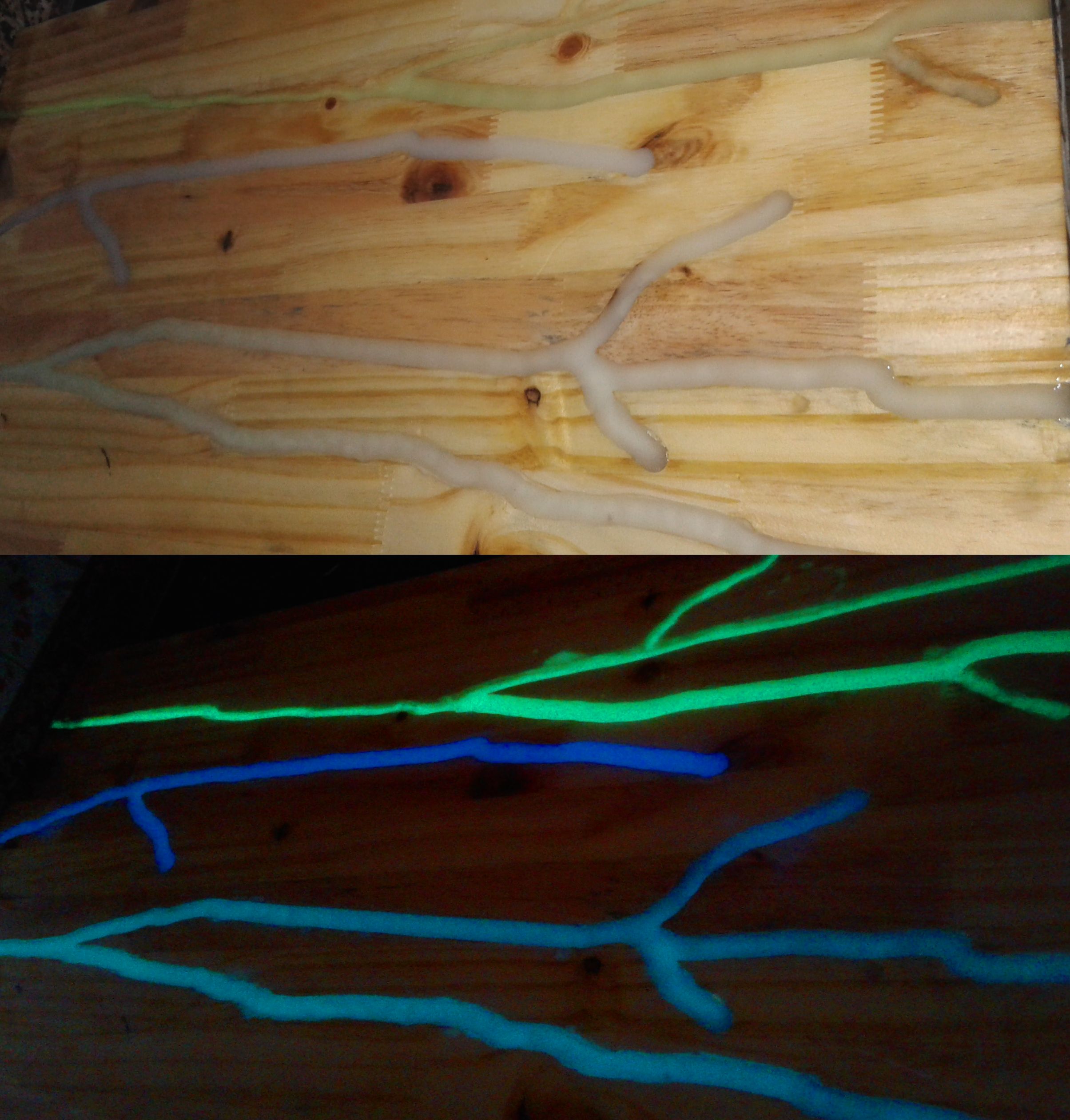
- Photoluminescent signalisation
- PHOTOLUMINESCENT BAND LLL
- Phosphorescent paints
- FLUORESCENT PAINTS
- BLACKLIGHT PAINTS
- PHOSPHORESCENT TAPES
- DECORATION
- PHOTOLUMINESCENT EMERGENCY EXIT SIGN
- SWITCHES
- STAIR NOSING
- PHOTO PAPER
- PHOTOLUMINESCENT ADHESIVE FILM
- RETRO REFLECTIVE TAPE
- Retroreflective paint
- PANEL PVC, ALU STEEL
- INFRARED INK AND X-RAY
- Phosphorescents Stones
- PRIMERS AND CLEARCOATS
- Luminescent road and cycle path
- Photoluminescent adhesives
- PHOTOLUMINESCENT PIGMENTS
- Fluorescents pigments and dyes
- Epoxy Resins and "River Table"
- Spraygun and airbrush
- Accessories
- Tactile signalization
- Protective Equipment
- Phosphorescent Papyrus
- Phosphorescent gems, pearls and jewellery
- Special effects paints
- Screen printing inks

Conforms to ISO 17398 and NF X08-050-1 standards
Regulatory luminance threshold
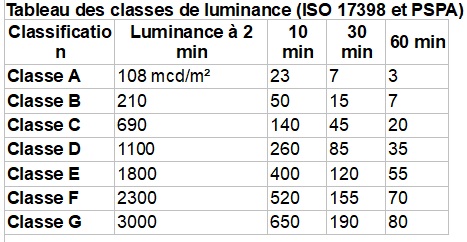
Phosphorescent safety equipment is subject to specific standards. In Europe, regulations require that this equipment meet at least Class C standards. For other types of equipment, this class remains the recommended benchmark. The international ISO 17398 classification divides luminance levels on a scale from A to G, according to measured performance. ARCO IRIS offers products with performance ranging from class D to even higher levels (class G+), ensuring optimal visibility even in extreme conditions.
ARCO IRIS® product performance
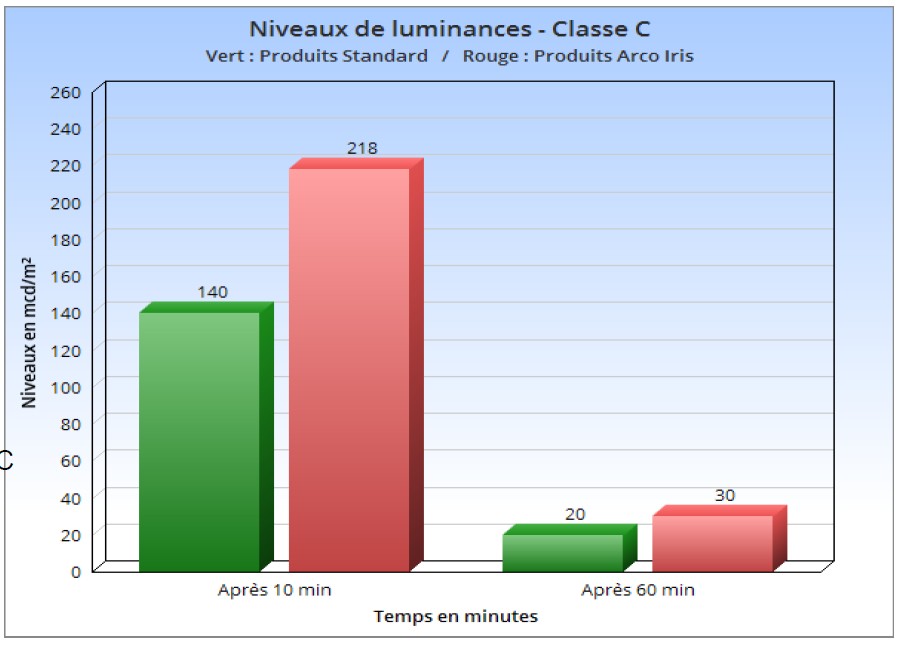
The photoluminescent equipment developed by ARCO IRIS consistently performs above Class C standards. Compliant with French standards NF X08-050-1 and NF X08-050-2, it ensures a high level of safety and effective signage, particularly in the event of a power failure or evacuation.
Technical data and regulatory marking of phosphorescent equipment
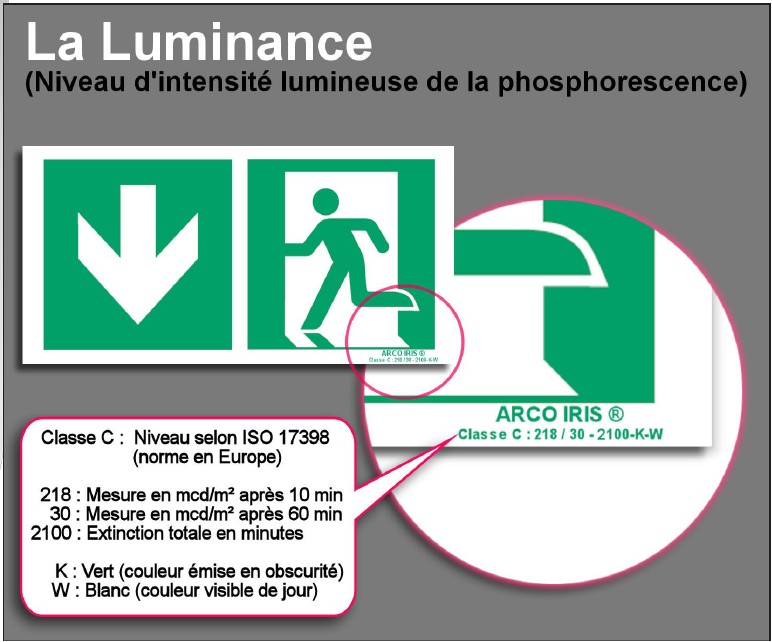
For each photoluminescent sign, the following characteristics must be specified :
the class achieved,
the luminance values measured 10 minutes and 60 minutes after the end of light excitation (reference lighting at 1000 lux),
and the total extinction time (in minutes), indicating how long the signal remains visible in the dark.
Certification, laboratory testing and traceability
All ARCO IRIS products undergo laboratory testing in accordance with DIN 67510-4 and NF X08-050-1 testing protocols. In accordance with the latter standard, each signal indicates the manufacturer's name and measured performance, thus ensuring complete traceability, approval, and an official declaration of conformity.
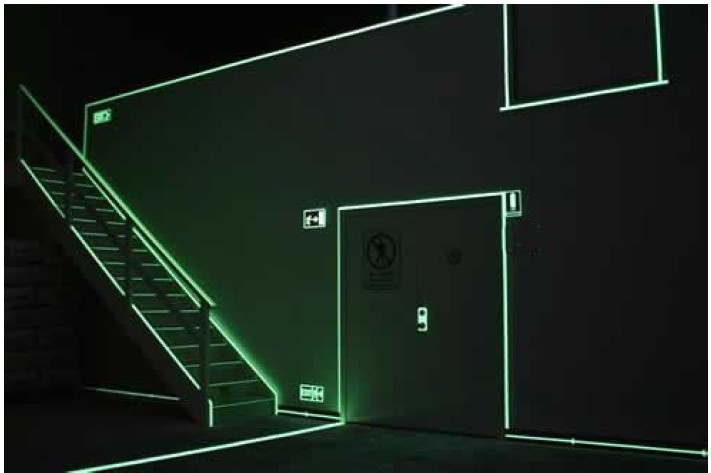
Measurement of photoluminescent luminance
Luminance values are expressed in millicandelas per square metre (mcd/m²). Three measurements are taken after the light source has been switched off. :
at 2 minutes,
at 10 minutes,
and at 60 minutes.
A fourth piece of data corresponds to the complete extinction time, i.e. the total time during which the product remains visible in the dark.
Technical definitions
Reference restitution: decrease in the luminance of a photoluminescent product excited under standardised illumination.
Useful restitution: same principle, but measured under more realistic or recommended illumination conditions.
Lux vs. millicandela/m²: lux measures the intensity of ambient illumination, while photoluminescent luminance is expressed in millicandela per square metre.
Phosphorescent products from class C to class G
We produce flexible PVC or PS/PC vinyl strips on request, as well as PVC, aluminium or even stainless steel sheets, made to measure and with the desired luminescence class. To achieve superior performance with photoluminescent classes up to G, we add more photoluminescent pigment coatings. This is of course limited by the type of material:
- for flexible strips and adhesives, it is possible to go up to class E
- for all rigid or semi-rigid substrates such as PVC or metals, we manufacture up to class G
The increase in photoluminescence with pigment loading will affect the thickness of the material, whether it is a vinyl strip, which will increase from 0.3 to 0.5 mm, or a PVC sheet, which will increase from 1.2 to 1.5 or 1.6 mm.
We would like to remind you that most of our materials undergo fire resistance testing: for example, we recently developed a flexible photoluminescent strip for use in trains travelling through European tunnels, with a fire resistance rating.
We can carry out various tests with our partner laboratories to obtain certification for your materials. We support you every step of the way, from manufacturing to approval.
List of Arco Iris phosphorescent equipment
Phosphorescent switch stickers
Effectiveness of different types