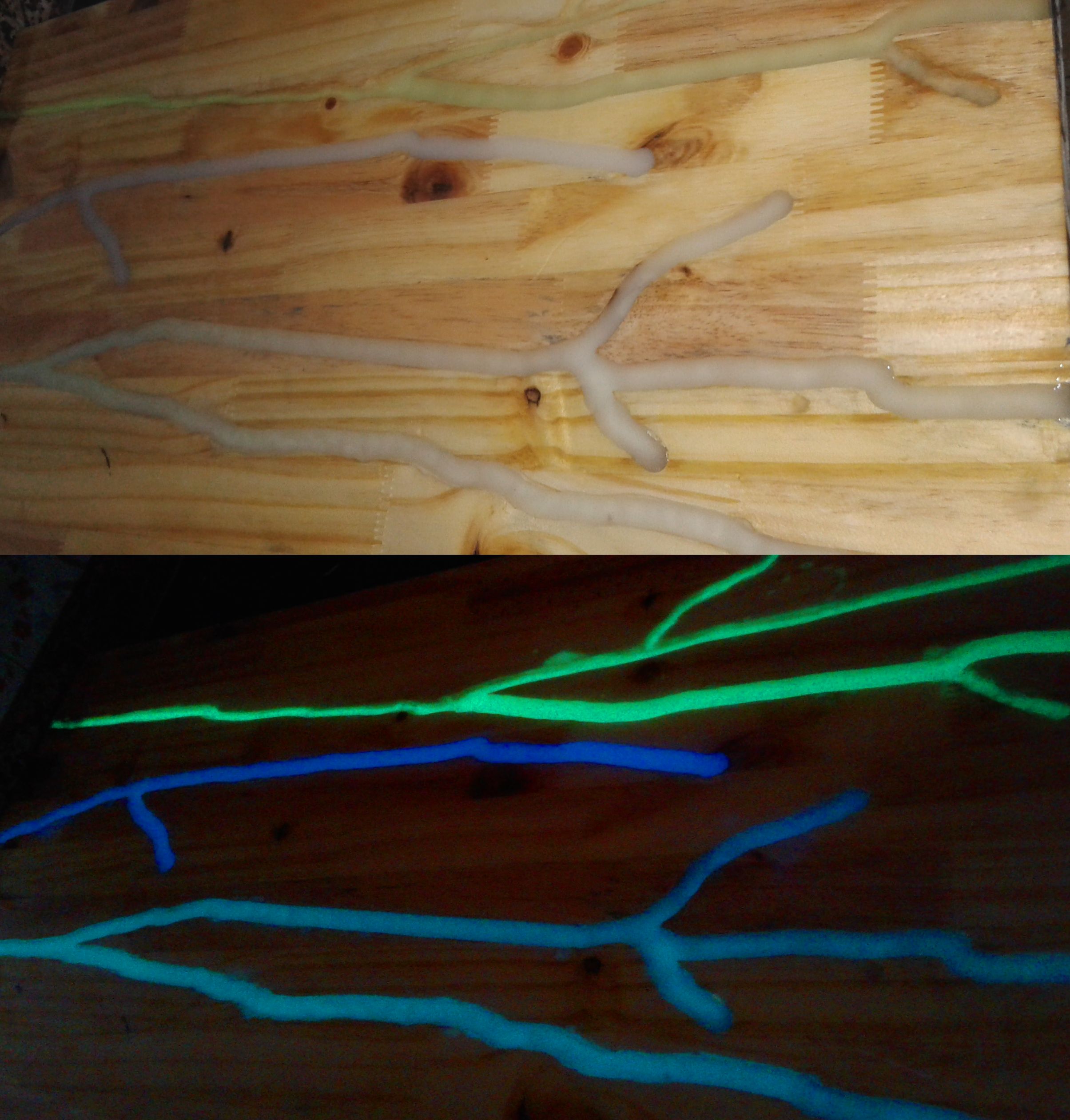
- Photoluminescent signalisation
- PHOTOLUMINESCENT BAND LLL
- Phosphorescent paints
- FLUORESCENT PAINTS
- BLACKLIGHT PAINTS
- PHOSPHORESCENT TAPES
- DECORATION
- PHOTOLUMINESCENT EMERGENCY EXIT SIGN
- SWITCHES
- STAIR NOSING
- PHOTO PAPER
- PHOTOLUMINESCENT ADHESIVE FILM
- RETRO REFLECTIVE TAPE
- Retroreflective paint
- PANEL PVC, ALU STEEL
- INFRARED INK AND X-RAY
- Phosphorescents Stones
- PRIMERS AND CLEARCOATS
- Luminescent road and cycle path
- Photoluminescent adhesives
- PHOTOLUMINESCENT PIGMENTS
- Fluorescents pigments and dyes
- Epoxy Resins and "River Table"
- Spraygun and airbrush
- Accessories
- Tactile signalization
- Protective Equipment
- Phosphorescent Papyrus
- Phosphorescent gems, pearls and jewellery
- Special effects paints
- Screen printing inks
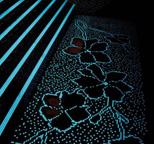

LLL: Luminescent Link Line
Derived from the English term ‘Low Location Lighting’, the acronym LLL refers to a standardised system of photoluminescent signage and guidance designed for emergency evacuation.
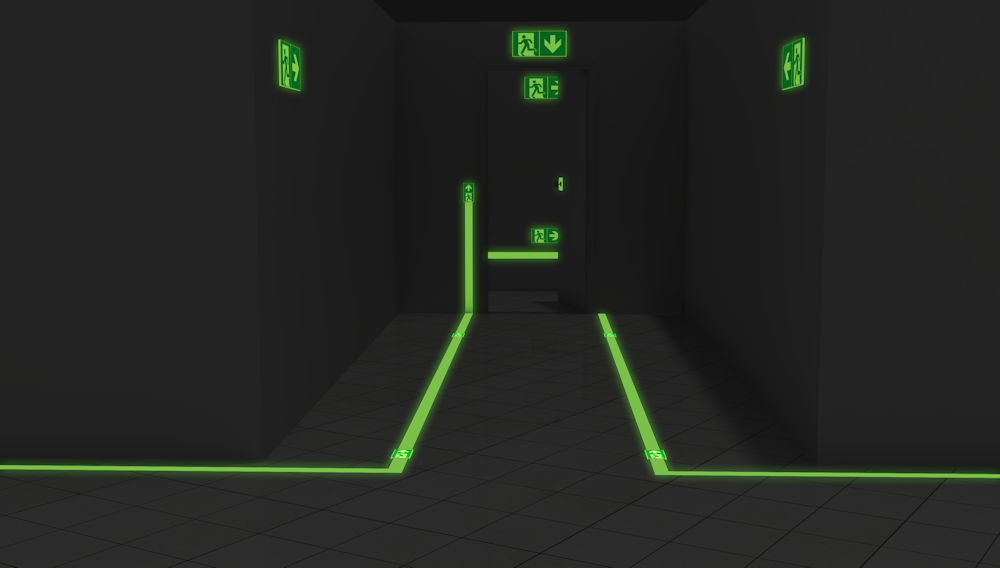
This system relies on the use of photoluminescent signs and strips, enabling occupants of a building who find themselves unexpectedly in the dark to visually orient themselves and reach exits or assembly points. LLL guidance consists of photoluminescent equipment (strips and signs) installed in rooms, corridors and stairwells to form a continuous line that is clearly visible in the dark, marking the entire evacuation route to the exits.
The locations of the phosphorescent evacuation signs
Photoluminescent devices must be installed in the following locations:
Lower areas
Doors and access systems
Stairs, ramps and handrails
Directional signage
Areas with obstacles
Additional safety information
The LLL journey: three fundamental principles
Guide lines must be continuous, without any breaks.
Safety directional signs must be placed close enough together.
The signs must remain visible from any point in the room.
Along an escape route, each sign must be visible from the previous one.
A sign must be installed at every change of direction.
Installation of the LLL
Guidelines
The guide lines mark out the escape route. They consist of photoluminescent adhesive strips at least 25 mm wide, laid out in a continuous, unbroken line.
They are installed at floor level:
on the floor,
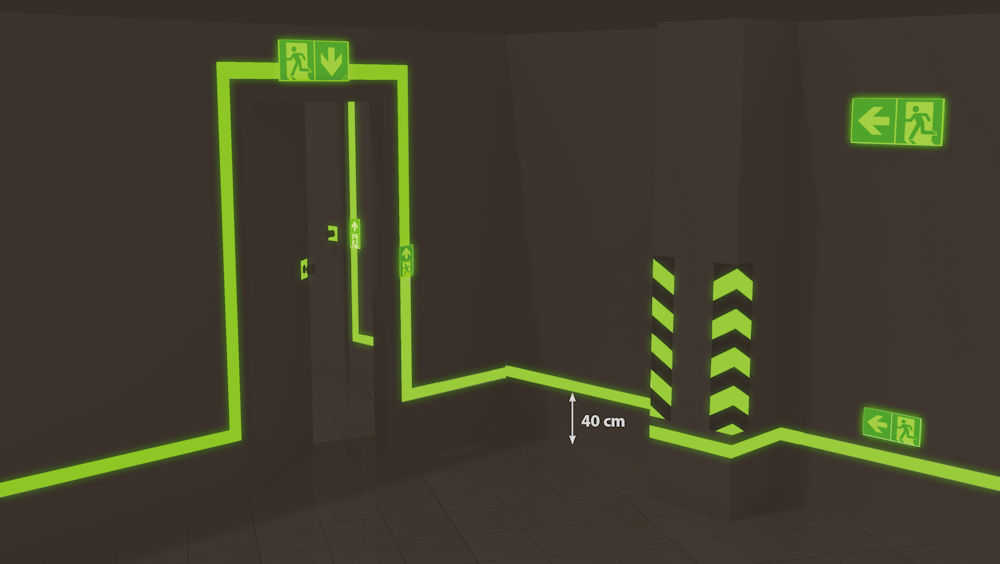
or on the wall, at a low height (the highest point must not be more than 40 cm above the floor).
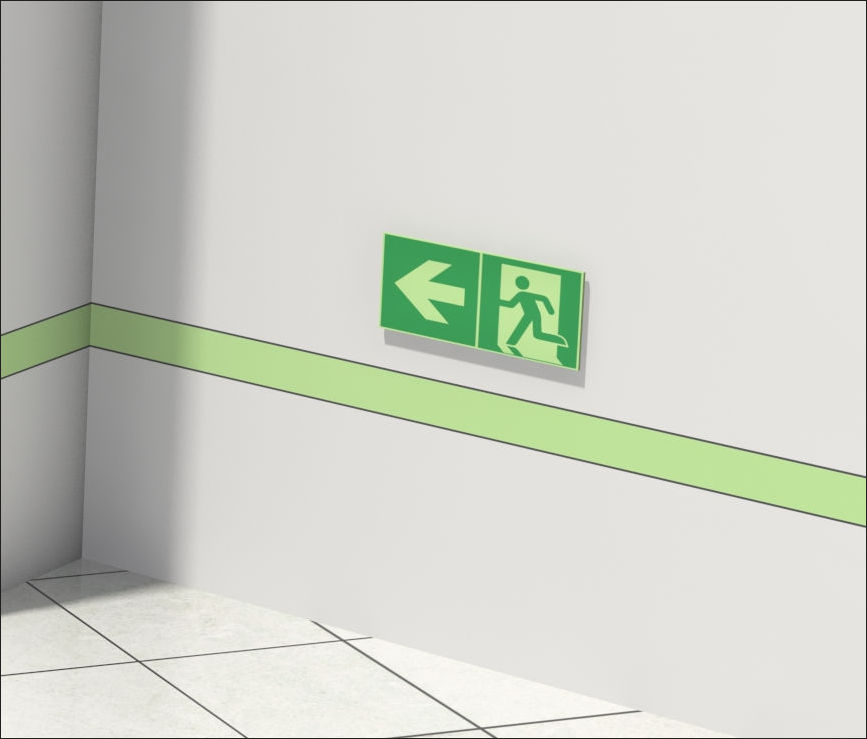
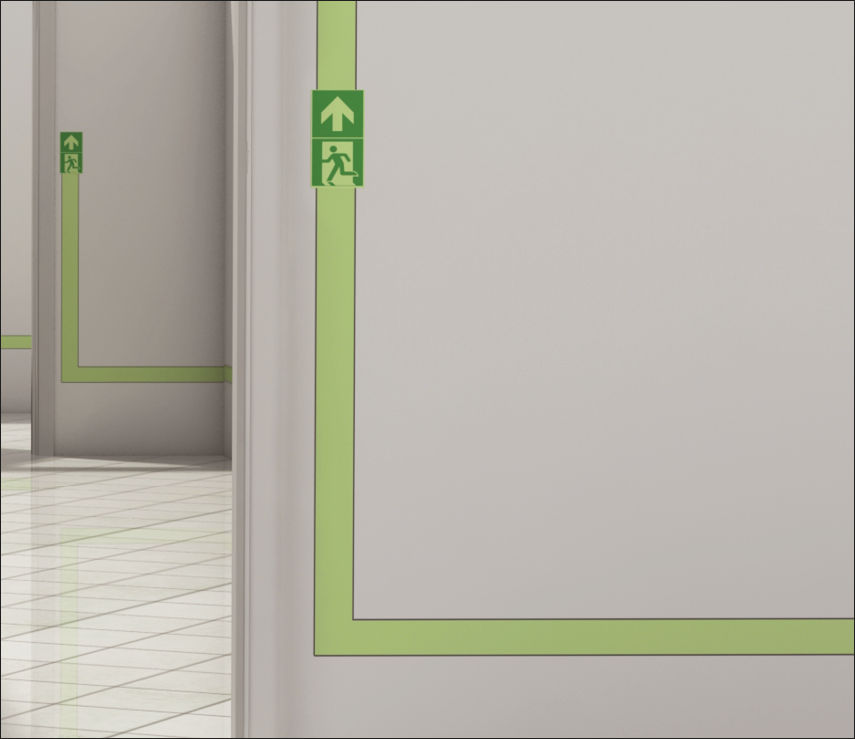
The lines must be marked on both sides of the escape route. A single side line is permitted where the corridor is less than 2 metres wide, preferably on a wall without any openings (doors) or intersections. To ensure optimum visibility and adequate lighting, the lower areas must not be obstructed.
In open spaces with no walls nearby, the route must be marked on the floor by two parallel lines, positioned on either side of the path. Where a door does not constitute an exit, the guide line must go round it on the floor.
If this is not possible, an exceptional interruption is permitted for a maximum length of 2 metres, provided that a directional sign is installed where the line resumes. Guide strips must never be laid directly over doors.
The doors
As part of the LLL guidance system leading to exits, it is essential to clearly mark the door frames of emergency exits.
This marking is carried out using photoluminescent tape with a minimum width of 25 mm, applied to all or part of the door frame (architrave or wall).
The tape must run continuously around the door. A maximum interruption of 10 cm is permitted only where there is an obstacle, such as a light switch. The type of tape, its positioning and the method of marking must remain consistent throughout the entire evacuation route.
In a corridor less than 2 metres wide, the strip may be installed on one side of the door only, on the side of the handle, up to the height of the handle.
However, if there is a risk of confusion, the door must be fully framed.
The panic bar or handle must be clearly visible, either:
by a photoluminescent plate positioned in the background,
or by a photoluminescent strip at least 25 mm wide applied to the handle or along the entire length of the push-button.
The stairs
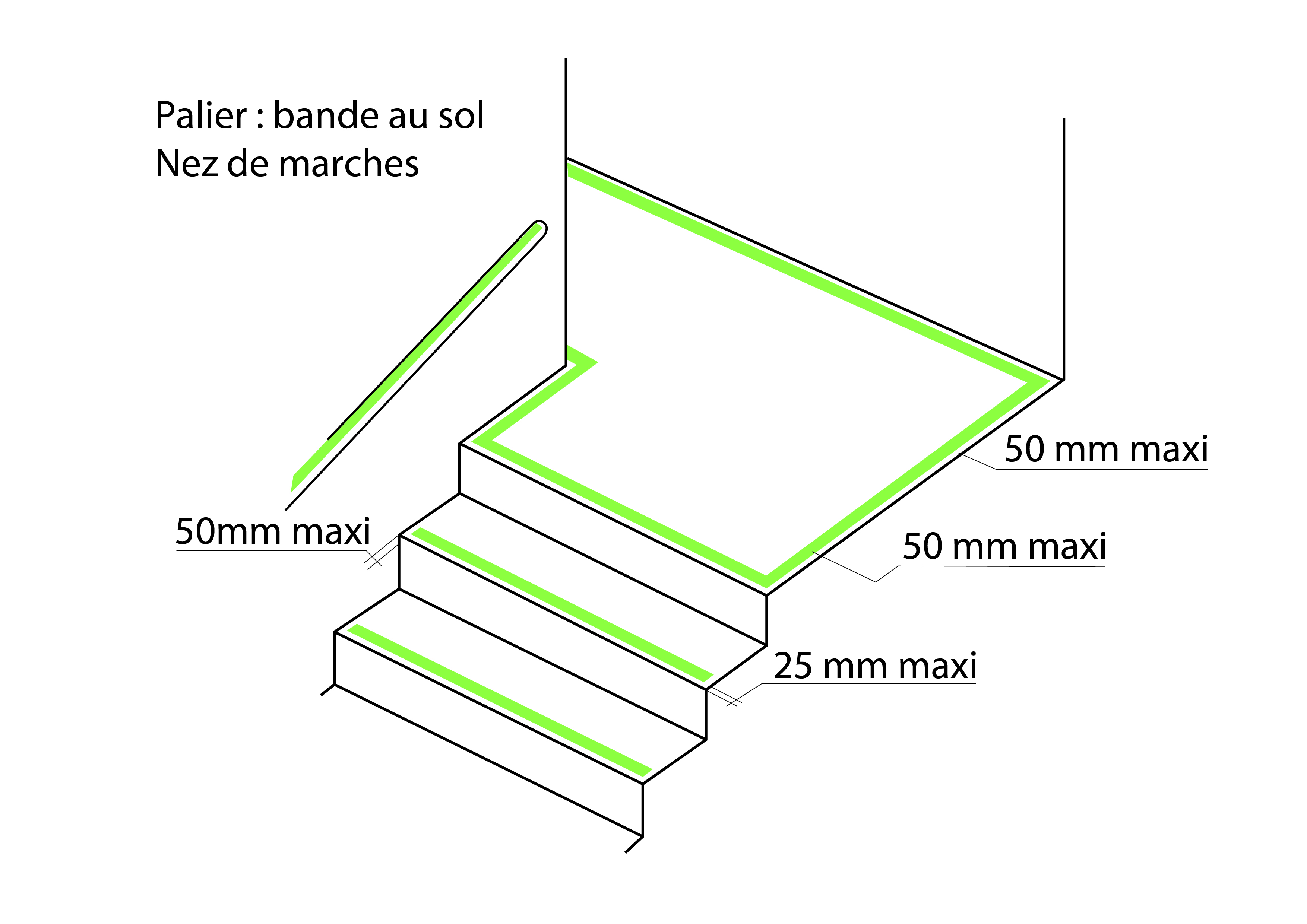
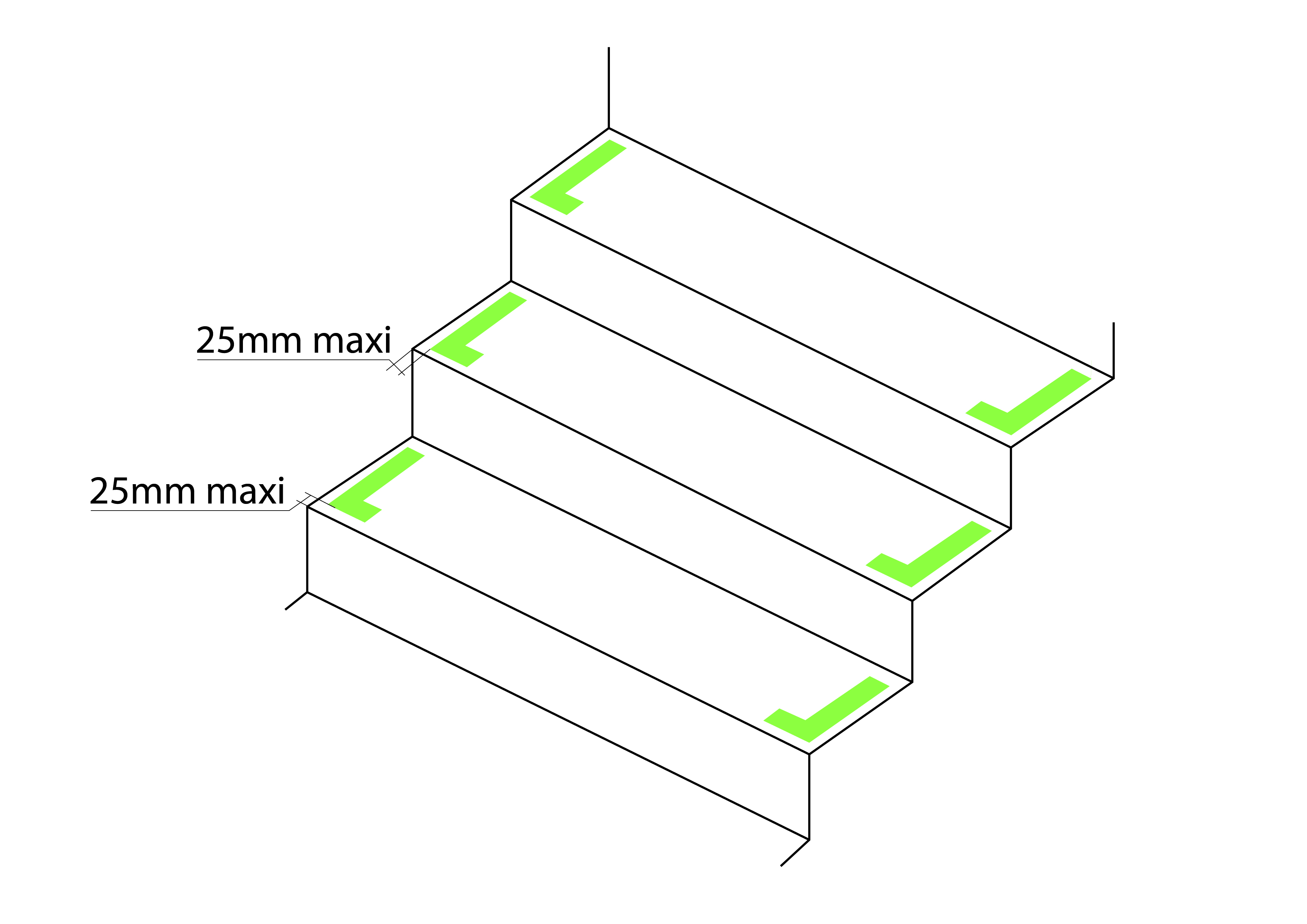
LLL photoluminescent guidance must remain continuous at changes in level. Steps, landings and ramps must be marked consistently and identically throughout the building, using photoluminescent strips, L-shaped markers and step nosings.
Each step must be marked by a strip 20 to 50 mm wide, laid along the entire length of the step.
A maximum offset of 5 cm at the end of the step is permitted. The strip must be installed parallel to the step nosing, at a maximum distance of 25 mm.
Steps may also be marked by ‘L’-shaped markers positioned on the left and right corners, provided that the width of the staircase is less than 2 metres.
The dimensions of these markers are standardised. Handrails must be marked with a photoluminescent strip at least 25 mm wide, applied to the top, with no gaps exceeding 10 cm. The transition between a landing and a staircase must be clearly identified. A continuous strip, on the floor or on the lower part of the wall, must be applied along the entire length of the first and last steps to indicate the start of the staircase, whether approaching from the top or the bottom.
Each change of floor must be indicated by a photoluminescent sign showing:
the name of the staircase,
the floor number,
the direction to follow.
Directional signals
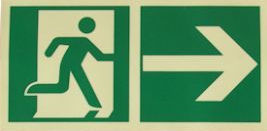
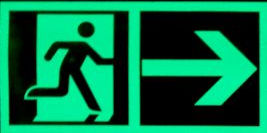
Photoluminescent directional signs remain visible in the dark and indicate the direction of exits.
In an LLL route, they can be incorporated:
in the upper section (above 1.80 m),
in the lower section, within the guide strip or just above it.
The minimum dimension of a sign must be greater than 50 mm on its shortest side.
Signs may be accompanied by explanatory text, for example ‘Exit’.
The obstacles
Any obstacle on the LLL route (corners, kerbs, changes in level, pillars, etc.) must be marked using hatched photoluminescent tape, with a minimum width of 25 mm.
Colour code for the hatching:
Black: high-risk area
Green: normal conditions
Red: fire hazard or restricted access
Blue: mandatory
Additional signage
The LLL photoluminescent guidance system can be supplemented with additional equipment such as photoluminescent arrows, studs or steps. Under no circumstances should these elements replace the main lines and components of the LLL, nor should they cause confusion or create visual clutter in the existing signage.
Additional requirements for LLL
Norm NF X 08-050-1
The components of the LLL photoluminescent guide must be classified as Class C.
They must also pass the following additional tests:
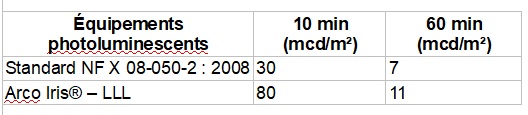
After excitation at 25 lux for 15 minutes using a 4000 K white fluorescent lamp, the minimum luminance required is:
30.0 mcd/m² after 10 minutes
7.0 mcd/m² after 60 minutes
Arco Iris LLL products meet these requirements and exceed the specified thresholds.
Additional luminance tests – LLL photoluminescent guidance
Lighting conditions:
Cool white fluorescent lamp, 4000 K – 36 W, illuminated at 25 lux for 15 minutes
Glow-in-the-dark safety paints
ARCO IRIS SAS’s phosphorescent safety markings and paints are designed to make escape routes, obstacles, staircases, doors and emergency equipment visible without the need for electricity in the event of a power cut or smoke. Depending on the application, ARCO IRIS offers various systems: acrylic paints (walls, corridors), paints/varnishes for smooth surfaces, and two-component coatings such as epoxy or PU for high-traffic floors (concrete, tiles, metal, wood, PVC). Application is by roller, brush or spray gun, onto a clean, degreased surface. For two-component products, the resin and hardener must be mixed in precise proportions and then homogenised before application. Performance meets the requirements of NF X 08-050 (Class C, luminance tests).
Photoluminescent stair nosing
ARCO IRIS SAS’s photoluminescent stair nosings are essential safety features for enhancing safety on staircases, in corridors and in high-traffic areas. They ensure that risers and step edges remain visible in the dark, thereby facilitating safe movement and reducing the risk of falls or disorientation in an emergency.
Designed for use on a variety of surfaces — concrete, metal, wood, tiles or industrial flooring — they come in the form of strips or rigid profiles suited to their intended purpose.
Available in adhesive versions or those requiring mechanical fixing, they must be installed cleanly, without any rough edges. All stair nosings meet the criteria of standard NF X 08-050, guaranteeing sufficient luminance after light exposure and long-lasting performance in real-world conditions
Glow-in-the-dark evacuation plan
ARCO IRIS SAS’s photoluminescent evacuation signs are signage devices that clearly indicate evacuation routes, emergency exits and assembly points, even in total darkness.
Thanks to an integrated photoluminescent agent, these signs absorb ambient light and then emit it in the dark, ensuring passive visibility – which is essential during power cuts or in the event of smoke. They are suitable for a variety of surfaces: walls, doors, shop windows or metal frames, and can be fixed using adhesive or screws depending on the type of environment. Their design strictly complies with the requirements of standard NF X 08-050, particularly in terms of minimum luminance after excitation and durability.
These plans significantly improve occupant safety by making evacuation routes intuitive in an emergency.
Pictograms in accord with EN ISO 7010
Arco Iris-approved and certified products
Phosphorescent signage in tunnels