- Photoluminescent signalisation
- PHOTOLUMINESCENT BAND LLL
- Phosphorescent paints
- FLUORESCENT PAINTS
- BLACKLIGHT PAINTS
- PHOSPHORESCENT TAPES
- DECORATION
- PHOTOLUMINESCENT EMERGENCY EXIT SIGN
- SWITCHES
- STAIR NOSING
- PHOTO PAPER
- PHOTOLUMINESCENT ADHESIVE FILM
- RETRO REFLECTIVE TAPE
- Retroreflective paint
- PANEL PVC, ALU STEEL
- INFRARED INK AND X-RAY
- Phosphorescents Stones
- PRIMERS AND CLEARCOATS
- Luminescent road and cycle path
- Photoluminescent adhesives
- PHOTOLUMINESCENT PIGMENTS
- Fluorescents pigments and dyes
- Epoxy Resins and "River Table"
- Spraygun and airbrush
- Accessories
- Tactile signalization
- Protective Equipment
- Phosphorescent Papyrus
- Phosphorescent gems, pearls and jewellery
- Special effects paints
- Screen printing inks

Standard reference : ISO 3864-1:2011
The size of photoluminescent safety signs is not chosen arbitrarily: it is determined based on the maximum distance at which the sign must remain legible. The ISO 3864-1:2011 standard defines a simple mathematical relationship between the height of the pictogram and the viewing distance.
Two formulas are used depending on the parameter being sought :
The maximum viewing distance is calculated by multiplying the viewing distance factor by the height of the pictogram;
conversely, the minimum height of the pictogram is calculated by dividing the viewing distance by that same factor.
In these calculations, only the height of the pictogram design is taken into account, not the overall dimensions of the sign or its width. This rule is essential to ensure that signs are interpreted consistently and correctly.
The viewing distance factor Z₀ is set at 60 in accordance with ISO 3864-1, and applies to all the signage formats under consideration. The standard tables thus link precise dimensions of signs and graphics to maximum viewing distances ranging from a few metres to over thirty metres, depending on the sizes selected.
Installation of photoluminescent signs based on distance
Special considerations for high-rise buildings In the specific case of high-rise buildings, simply applying standard formulas is not sufficient. It is essential to take into account actual viewing angles, the layout of the spaces and evacuation routes in order to correctly determine the size and location of the signs.
In this context, the general rules applicable to evacuation signage remain valid, but must be adapted to the architectural complexity of the building.
The positioning of signage
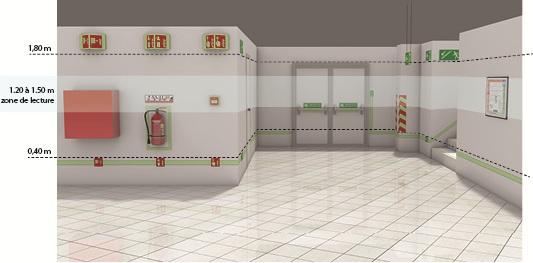
The positioning of safety signs is regulated and must meet a number of functional requirements. A sign must be installed in such a way that it remains visible from any viewing angle, and placed as close as possible to a light source to ensure optimal visibility in the case of photoluminescent signage. The signage is organised into three distinct levels.
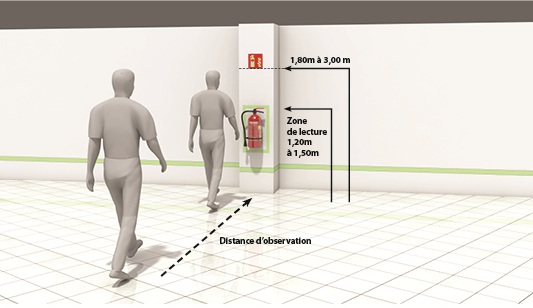
Height adjustment
The upper level corresponds to a height of between 1.80 m and 2.50 m, measured from the lowest point of the sign. This zone is reserved for signs indicating facilities or emergency exits, which must remain visible above the crowd.
Where a facility is not directly visible, it must be indicated by a directional arrow. Danger signs covering an entire area are also positioned at height, generally above 2 m.
Intermediate position
Le niveau intermédiaire se situe entre 1,20 m et 1,50 m, correspondant à la zone de lecture naturelle de l’utilisateur. Il concerne les informations liées à l’utilisation des équipements (consignes, plans, informations extincteur), ainsi que les signaux de danger, d’interdiction ou d’obligation placés à proximité immédiate du risque ou du dispositif concerné.
Pour les équipements tels que les extincteurs, un marquage photoluminescent périphérique est requis afin de les rendre immédiatement identifiables.
Low positioning and floor markings
The low level refers to markings where the highest point is no more than 0.40 m above the floor. This applies to floor markings and continuous photoluminescent guide lines, positioned either directly on the floor or at the bottom of walls. These features play a vital role in helping people find their way in the event of smoke or a complete loss of visibility at height.
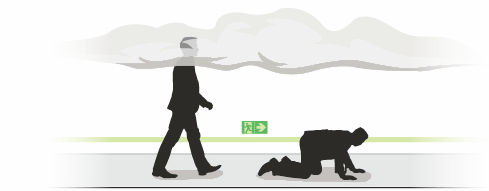
Mounting methods and visibility zones
Signs can be fixed mechanically (by screwing, riveting, gluing, suspending, inserting into profiles or crimping) or using adhesive, depending on the site layout and the nature of the surface.
Regardless of the fixing method, the main objective remains to optimise the field of view.
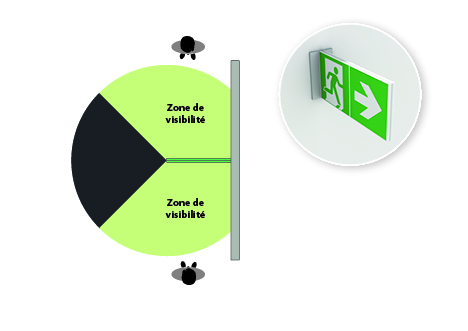
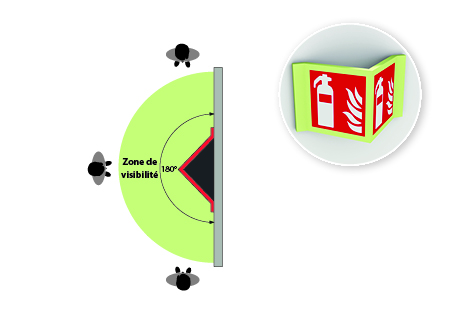
For a sign positioned against a wall, the usable viewing angle is estimated at 90° out of 180°. When signage is installed perpendicular to the wall, in a so-called double-sided ‘flag’ configuration, the viewing angle reaches 120° out of 180°. Double-sided suspended signs, meanwhile, offer maximum visibility, at 180° out of 360°, whilst bidirectional corner signs ensure simultaneous readability over 180°.
It should be noted that perpendicular signs must be installed at a minimum height of 2.20 m to ensure traffic safety and optimal legibility. This methodical approach to the size, positioning and fixing of signs ensures compliant, effective and durable signage, fully in line with the requirements of ISO 3864-1:20
Pictograms in accordance with EN ISO 7010
Arco Iris-approved and certified products
Phosphorescent signage in tunnels