


No products available yet
Stay tuned! More products will be shown here as they are added.


Creating something with a truly unique special effect is easy and within everyone’s reach with glow-in-the-dark decorations. By using a phosphorescent pigment (there are dozens to choose from) and epoxy resin, you can create a luminous and natural piece by combining all sorts of objects, shapes and ideas with phosphorescent pigments suspended in their transparent medium – the epoxy resin!
How does it work? How do you do it? What are the proportions? How long does it glow for? Let’s try to answer all these questions briefly.
Photoluminescence is a natural and harmless phenomenon produced by a molecular reaction. It works through exposure to any type of light (this is the excitation, or recharging with energy). It can glow for several hours and even up to 12 hours depending on the colours, and its effectiveness and lifespan can be measured in decades…!
To make the mixture, simply add the powders (around 10 per cent), along with a medium that allows light to pass through – a transparent medium.
There are pros and cons to everything, and you need to make the right choice to ensure your project is a success.
Strontium aluminate powders come in several sizes: some are very fine and light; they diffuse light well, float easily due to their microscopic weight, and glow for a slightly shorter time. Other particles are larger, heavier and brighter: there are fewer of these, so they diffuse less light, and, above all, they have the major drawback of sinking more quickly in a mixture because of their weight.
You should choose your phosphorescent pigment first and foremost based on the colour you want (the colour emitted in the dark! Phosphorescent resins and pigments have no colour in daylight, as the powders are almost colourless when mixed into a transparent epoxy resin).
When choosing phosphorescent pigments, we recommend starting with a ‘strong’ pigment in a green or turquoise shade, with a fine or very fine particle size of around 5 to 15 microns. Reserve the use of coarse pigments for fine, fast-drying phosphorescent resins.
This is a very important decision. To make this choice, and before considering a resin-pigment mixture, it is crucial to understand which resin to use for a phosphorescent casting, as well as how the drying and curing processes work. We’ll explain everything about volume, temperature and the exothermic process in the next section.
This isn’t a simple question, and many users are misled by certain photos and videos posted on social media. What are the real possibilities, which products should be used to create coloured phosphorescent resins, and why can’t dyes be used? We explain this in this article. The possibilities boil down to using coloured bases or adding fluorescent powders.
It is mainly a question of making the most of the resin’s properties, particularly its viscosity, as well as its ‘gel time’, which is the curing time. Asking yourself ‘which phosphorescent products to use to prevent sedimentation’ also means choosing the right pigments and calculating the mixing quantities correctly, to avoid sedimentation (where everything settles at the bottom).
The intensity of phosphorescence is known as luminance. Phosphorescence is the emission of light; whilst it cannot match that of an electric lamp, it can still reach respectable levels!
Different levels of performance can be achieved. To find out which pigment to use to create a super-phosphorescent resin, we invite you to follow our expert advice on the subject. In summary, the luminous efficiency will depend on your choice of pigment types, the mixing ratios, the background colour, and, of course, the type of light source.
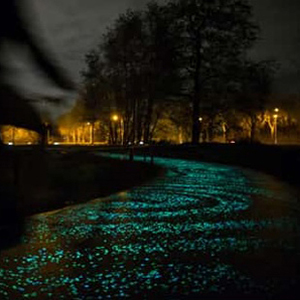
Glow-in-the-dark stones, mosaics and glow-in-the-dark gravel

We offer a selection of the best epoxy resins to make glazes or castings. Easy to use, the two-component epoxy resin offers many advantages over other resins (Polyester, Polyurethane, etc.): it is odourless, non-toxic, doesn’t shrink during drying, completely transparent, and shows excellent mechanical properties, especially resistance. Learn how easy it is to make a river table: Epoxy resins can be mixed with "candy” pearl or translucent shades or pigments. This opens a whole world of extraordinary decorative possibilities. They are called "River Tables" because of their coloured and pearl epoxy casting effect on resin holding two pieces of raw wood, thus reminding us a river which flows across the land. It’s also possible to make a table with casting and phosphorescent inlay. Resoltech Resin: Pro technology products Arco Iris distributes resins from Resoltech, a French company specialized in epoxy resin technology. Always on the cutting edge of innovation, the new resins are more translucent and more resistant to UVs Here are our epoxy resins for "River Table", in wood, concrete, etc. - Thick WWA Epoxy Resin known as "casting" (1-30cm) - 4000 Epoxy Resin, extra thick glaze (0.1-1cm) - 1010 Epoxy Resin, water-based product for impregnation or clear coating

Meant for the industry sectors, the phosphorescent pigments have the capacity to store and emit light: they load up with light (sun, electrical, UV) and release slowly the stored energy by glowing in the dark. Definition* : the word photoluminescent covers in general all types of pigments that can emit light thanks to a luminous excitement. Thus, to be more precise, we will talk about phosphorescent pigments. LUMINANCE : The pigments glow over a variable period of time and in a quick decay curve, that will stabilizes itself during long hours. The luminance is measured in microcandela/sqm. The luminance can totally extinguish days after an excitement to light. The intensity of the glow will depend of the size of the pigment particle and of its colour: green particles are larger and will glow longer. ASPECT : The pigment powders are colourless during the day TYPES OF PIGMENTS : We deal with the biggest choice of pigments, available in several models according to their colours, the size of the particles and their type (solvent or water based) We also produce a range of pigments coloured by day (please contact us by email only) ORDER: The easiest and quickest way is to order via our site (payment by check, credit card, wire transfer). Volume discount prices. Please contact us for a pro forma invoice. Send us an email to get a quotation for big quantities/ to get the full degressive price list For further informations about the preparation of the pigments and how to incorporate them, please see our PDF technical data sheets. Also ask for our technical application files (Application in Paints and coatings, Application in Inks, Application in Plastics)

Fluorescent pigments are available in more than a dozen different colours, packed in 1kg to 25kg bags (quick delivery 48h). They are coloured powders, highly concentrated, harmless, and quite easy to incorporate into plastics, paints or other. These pigments are fully compatible in aqueous phase or solvent. No grinding is required, they are mixed with any transparent medium, preferably by stirring. Pigments, as opposed to dyes, are insoluble very fine particles (below 15μm). Dyes are more specific products, which have the particularity to dissolve instantly and completely in some solvents only. That’s how they display a perfectly translucent colour of highest purity. You can find all of the necessary information on the product pages and in the pdf file below.

This category showcases our full range of accessories and protective equipment for decorative painters and bodywork professionals who apply glow-in-the-dark paint.
There are no safety precautions to follow when installing glow-in-the-dark equipment or accessories. However, when applying the paint, it may be necessary to take protective measures.
This is not because phosphorescent paint is particularly harmful, radioactive or toxic (which is absolutely not the case), but rather because, generally speaking, professional-grade solvent-based paints or spray paints can be irritating or harmful.
In addition to the items used for weighing, mixing and applying – which can be found in our product category below – you can also purchase protective equipment (gloves, respirator, coveralls) to use spray paints safely and without getting dirty!
When using volatile products, such as liquid paint sprayed to form aerosols, or when mixing powders, pigments or resins, it is important to protect yourself from dust and volatile solvents.
Our cartridge respirators contain several filters, including a carbon-based filter capable of capturing over 99% of volatile substances.
Of course, it is essential in all cases to work in a sufficiently well-ventilated area.
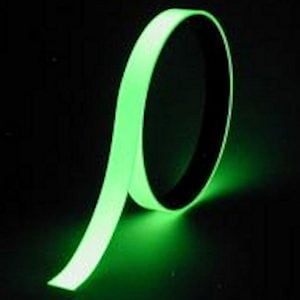
Regarding the fitting of phosphorescent or reflective accessories, such as adhesive strips, phosphorescent stair nosings, and many other photoluminescent accessories available on our website, we do not supply the adhesives.
For your information, an adhesive must be suitable and chosen according to the type of substrate (raw material) on which it is to be used.
It is possible to use epoxy adhesives, hot-melt adhesives, PVC adhesives, etc.
Particularly when working with phosphorescent materials, it is strongly recommended that you use a spray gun rather than a brush or, worse still, a roller. Why?
Not only because a greater proportion of the paint is transferred to the surface (the roller soaks up paint), but above all, when painting with an airbrush or spray gun, you do not touch the surface, so you do not leave any brush or roller marks. You’ll find a selection of affordable and effective tools on our website.
It is when you switch off the light and look at the freshly applied phosphorescent paint in the dark that you’ll realise how you’ve painted it:
In the dark, you’ll only be able to see the paint’s pigments; everything else will be invisible.
When spray painting, you atomise a cloud of paint and pigments very evenly, like a mist being sprayed onto the surface. This prevents gaps, excess paint and, above all, coarse brush marks.
Questions about glow-in-the-dark paint
Professional glow-in-the-dark paint
Decorative glow-in-the-dark paint
Stay tuned! More products will be shown here as they are added.


